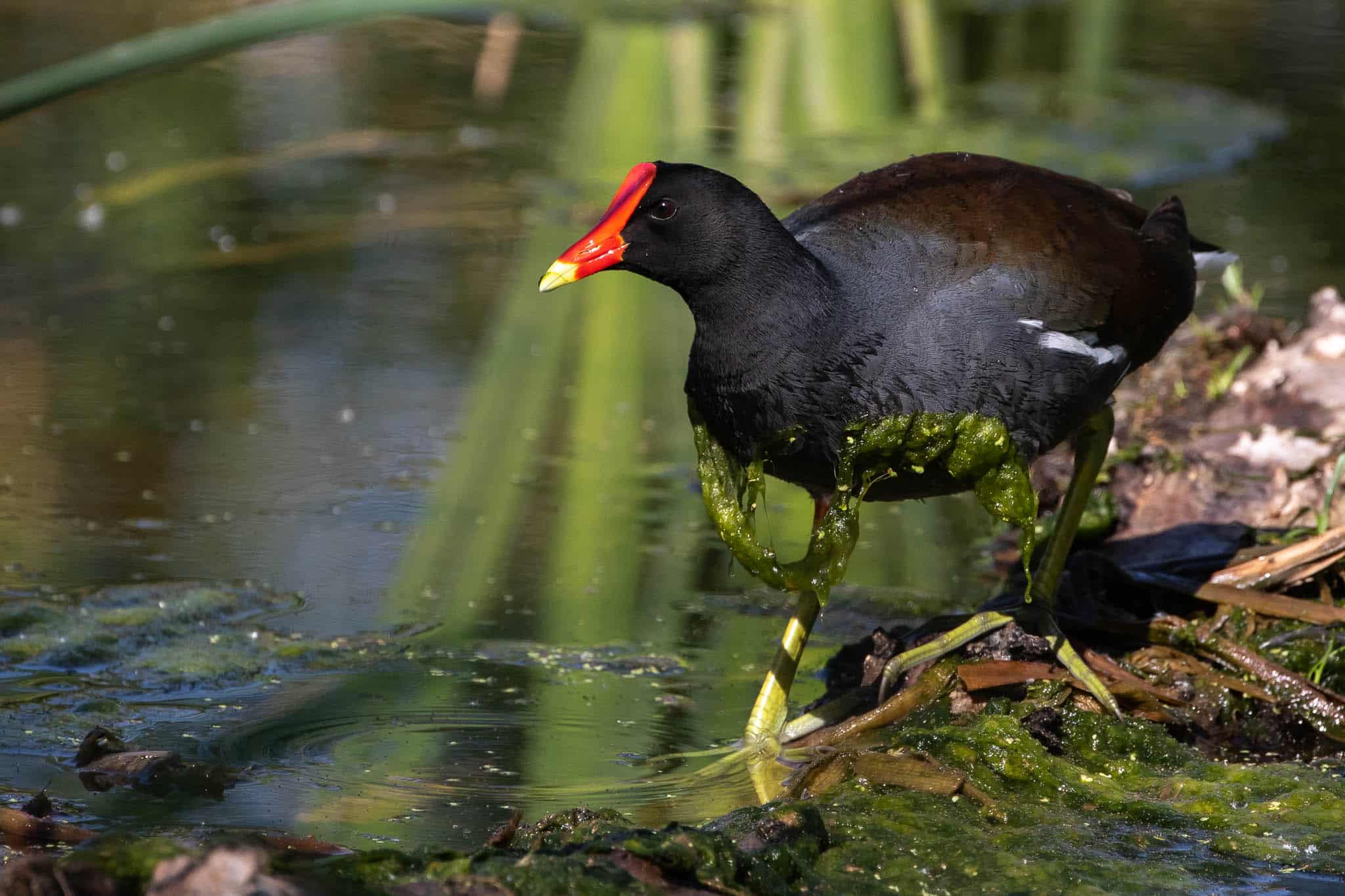
Common Gallinules breed at Sweetwater Wetlands and other marshy ponds during spring. Summer is the time to seek them out and try to catch a glimpse of adults and scraggly-looking juveniles. You’ll be happy you did, this is a stately black and brown rail with huge yellow feet and a bright red face shield and yellow-tipped bill. It is commonly associated with cattail marshes, ponds, canals, ditches, and rice fields, where it uses these big feet to walk atop floating vegetation. This species is ecologically and behaviorally intermediate between the American Coot and the rails—it swims and looks like a coot but is also adept at walking on vegetation like the typical rails. It feeds on plants, seeds, snails, and insects on the water surface, among submerged plants, and in shoreline vegetation. Like most marsh birds, gallinules are very vocal, giving loud whinnies and squawks that carry well through dense wetland vegetation.
Historically known in North America as Florida Gallinule, Black Gallinule, and swamp chicken, the name Common Gallinule was given in 1957, then changed to Common Moorhen in 1983. That name then reverted back to Common Gallinule recently when the North American populations were split from the Eurasian Moorhen. Common Gallinules range from southeastern Canada (in summer) down to Chile. There’s even an endangered subspecies in the Hawaiian Islands that mythologically brought fire to humans, its forehead being burned red in the process. Gallinules can be found in Southeast Arizona year round, Sweetwater a good spot during breeding season, but also check out El Rio Preserve or Willcox Lake.
Image by Scott Olmstead